

Communicating complex discounts at point of purchase
Client: Vodafone Australia
Customer Problem: Users felt little sense of loyalty for being an existing and long term customer
Business Challenge: Communicate a complex discount system at point of purchase without overwhelming users with business rules and disrupting sales
My Role: Design and test the UX and communication of a compounding discount offer through checkout and confirmation emails — balancing complex eligibility rules with a checkout experience that didn’t overwhelm or slow down sales.
Outcome: Conversions jumped 45% in the first few days after launch — proof that customers understood a genuinely complex discount system once it was designed around how they actually wanted to read it
Discovery
To improve a validated lack of loyalty in customers, Vodafone offered Bundle & Save, a discount on any second, third, etc services that customers had or purchased with us. The complexity was in the eligibility (as all services were eligible) and compounding discount—for example, the more services you bought, the more discount you got on all services. To add to this, the solution was going to be launched in phases, where in Phase 1 we couldn’t tell users how much they were saving, up to Phase 3 where we could detect users’ number of services and clarify their discount.
As this was a pre-approved concept, I dove into scoping with the aim to then move into the ideation and test comprehension of the copy.
Scoping
I started by creating a matrix of the different user groups (new and existing customers, existing customer upgrading, existing customers adding NBN, etc.).
I then wanted to get a better idea of scope and start mapping the flow of information reveal on the Vodafone journeys. I started by thinking holistically, identifying key locations for where the Bundle & Save information needed to be placed, for both awareness/marketing journeys and in checkout, etc.


I then focused on a visual to explain the concept, so that I could run early comprehension testing and start thinking about how to break this down into information pieces for along the different journeys.

Early concept testing showed users understood the concept, saw the value, and might swap service providers if they saw more reassurance.

Pattern research
To prepare for design, I researched how discounting was communicated by our competitors and by other industries. I captured patterns and sketched along the way.

Design
I then ran a sketching session with the squad to generate ideas and to get ideas from non-designers.
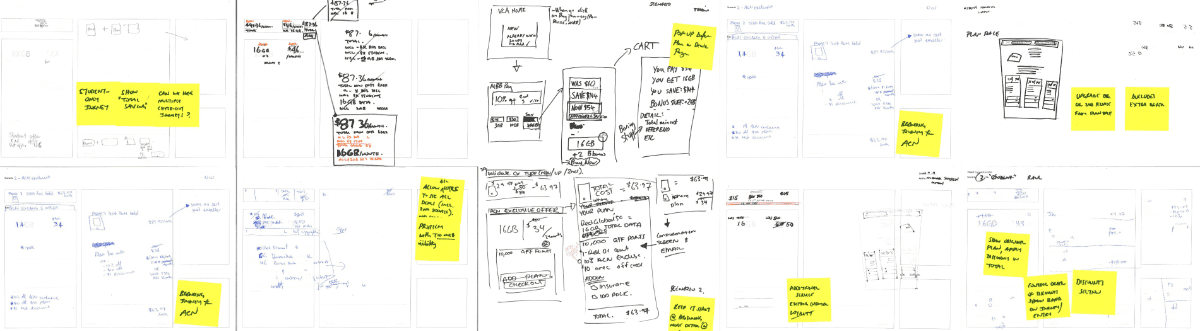
I developed these ideas into first iteration wireframes for key journeys and began user testing, evolving the designs into hi-fi designs and testing again.

We tested eight new and eight existing users, taking them through different scenarios, and mapped the results on the wall, using color coding, to see the successes and failures. Using pink sticky notes for failure, the big patches of pink in the results gave a clear message the initial concept wasn’t working due to information overload and conflicting with other ‘hot offers’ information.

Key insights: Some users didn’t care about discount details, while others wanted the detail.
When in the Cart and Checkout, users didn’t want to be overwhelmed with discount and rule complexities, such as eligibility – this needed to be addressed earlier in the journey.
But the info needed to be there for those who might be stalled and call care.
Design iteration
We needed to reconsider how we spoke to 3 User Types:
- Skimmers-those who just want to know what they’re paying, and don’t need to know the reasons for discounts or how they are calculated
- Readers-those who want to know the reasons for discounts and/or how they are calculated
- Detailers—those who want to know the reasons for discounts, how they are calculated, and other details such as eligibility
I used a mix of content and styling strategies to achieve this, as well as defining a variation matric to speak more directly to new and existing customer needs.


Outcomes
After launch, conversions rose 45% in the first few days—strong evidence that customers understood the new compounding discount offer and saw real value in it.
This was an amazing project to be a part of, as I really enjoyed the challenge of reducing such complexity into simplicity for customers.
Failing concept caught before launch
Initial testing showed the first design overwhelmed users with rules and clashed with other offers—testing exposed this early enough to fix before launch.
Solved for conflicting user types
Designing content and styling that served Skimmers, Readers, and Detailers, without burying anyone in information, was the core of what made the launch work.
Reduced complexity into something sellable
A compounding discount, eligible across every service combination, rolled out in three phases with different data available at each—explained clearly enough at checkout to lift conversions.